

KBT Tilt Switch
KBT tilt switches are designed for point-level and blocked-flow detection in silos, hoppers, chutes and bulk-material conveyor processes.
Showing all 3 results
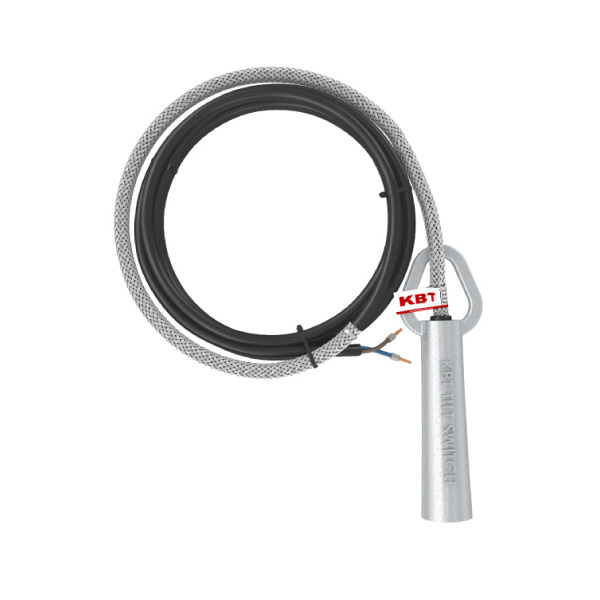


KBT tilt switches are designed for point-level and blocked-flow detection in silos, hoppers, chutes and bulk-material conveyor processes.
What is a KBT Tilt Switch?
The hanging probe tilts as material accumulates around it. Internal switching or an associated controller converts that movement into a usable alarm or process signal. Heavy-duty and high-temperature variants allow the sensing principle to be applied across different bulk solids.
A switch or sensor does not create safety integrity by itself. Its failure behavior, wiring, logic and final control element must be considered together and verified against the performance required by the application.
Typical applications
Relevant installations include silo high-level alarms, chute blockage detection, pile detection, material presence monitoring. Actual operating observations are valuable: drawings rarely show wind, carryback, washdown, structural movement or the way bulk material strikes a device.
- silo high-level alarms: verify the actual operating condition, mounting geometry and required response before selecting a model.
- chute blockage detection: verify the actual operating condition, mounting geometry and required response before selecting a model.
- pile detection: verify the actual operating condition, mounting geometry and required response before selecting a model.
- material presence monitoring: verify the actual operating condition, mounting geometry and required response before selecting a model.
How to select the right model
Separate mandatory characteristics from preferences. Contact utilization, positive opening, hazardous-area approval and permitted mechanical travel can be critical, while color or a familiar housing shape normally is not.
Create an equipment record containing the full model code, approved datasheet, terminal plan and selected settings. This makes quotations comparable and preserves the engineering basis for later replacement.
- Confirm the contact arrangement, utilization category and control voltage.
- Match the enclosure and ingress rating to dust, water, washdown and corrosion exposure.
- Check ambient temperature, cable entry, mounting dimensions and actuator geometry.
- For hazardous areas, verify the complete certificate and marking for the exact model.
Installation and commissioning guidance
Select the suspension point from actual material flow patterns. Allow the probe to deflect without striking the vessel and use the cable protection option recommended for abrasion, heat and falling material.
Carry out a controlled acceptance test under the manufacturer’s method. Confirm that reset restores readiness without an unintended start and that any startup bypass expires predictably.
Inspection and lifecycle care
Trend nuisance operations and slow or failed resets. Increasing event frequency often reveals a process, alignment, contamination or mounting problem before the device loses its function completely.
If the device is damaged or its state is uncertain, replace it with a verified configuration and inspect the target or process condition that caused the damage. Like-for-like replacement alone may reproduce the failure.
Specification, commissioning and lifecycle record
A dependable KBT tilt switch decision remains traceable from the operating requirement to the installed order code. Record the normal condition, abnormal trigger, required controller state, alarm or stop response, reset rule and inspection method before requesting quotations. This prevents commercial substitutions from changing the engineering function unnoticed.
Keep the approved datasheet, complete model suffix, terminal drawing, mounting sketch, certificates and commissioning result under the equipment tag. After replacement, adjustment, conveyor modification or control-software change, repeat the relevant physical proof test and update the as-built record. The test must demonstrate the field device, wiring, controller indication and final machine response rather than only a changing PLC input.
- Compare complete order codes and option suffixes.
- Confirm contact state under normal, actuated and fault conditions.
- Record the installed clearance, angle, tension, threshold or calibration.
- Inspect mounting, cable entries, seals, earthing and access.
- Set maintenance intervals from risk, environment, duty and failure history.
Frequently asked questions
Can a KBT tilt switch be used in dusty service?
Many models are intended for dusty bulk-solids environments, but the exact ingress and hazardous-area rating must be confirmed from the selected model code.
How is nuisance activation reduced?
Correct probe location, delay settings and a model suited to material density and flow behavior help distinguish normal flow from a true high-level or blockage condition.
Selection note: verify dimensions, operating principle, electrical data, environmental rating and certifications on the current datasheet for the exact ordered model.
What is KBT Tilt Switch?
Kbt Tilt Switch is a device used for measuring the tilt of an object in multiple axes with reference to an absolute level plane. They are small and compact instruments which make them a viable option for many applications where orientation or inclination detection is a key factor, such as warning systems on construction or agricultural vehicles. Alongside our vast range of inclinometers and inclinometer sensors, our tilt-switches at Level Developments also use highly accurate sensors to operate, gaining an advantage over alternatives such as mercury switches or rolling ball mechanisms.
Tilt sensors work by detecting changes in angle from a pre-set “zero” state. They are set with a maximum and minimum threshold in which the application will work or be safe to operate based on the specific application’s needs. If the tilt or inclination exceeds these threshold values in either direction, a relay will be engaged and the switch closed, thus sending an operation to an external device such as an alarm or warning light to indicate unsafe or non-working conditions.
| Brand | New Order Code | Old Order Code | Tilt Angle | Temperature Rating | Description |
| KBT | CB-39 | CB39 | 35° in any direction | -40°C to +80°C | Casting Body for Heavy Conditions |
| KBT | CB-39HT | CB39HT | 35° in any direction | -40°C to +190°C | Casting Body for Heavy Conditions + High Temperature Resistance |
| KBT | CB-39-KCT-601 | CB39-KCT601 | 35° in any direction | -40°C to +80°C | Casting Body for Heavy Conditions + Ball Float |
| KBT | CB-39-KCT-101 | CB39-KCT101 | 35° in any direction | -40°C to +80°C | Casting Body for Heavy Conditions + Extension Plate |
| KBT | CB-39HT-KCT-601 | CB39HT-KCT601 | 35° in any direction | -40°C to +190°C | Casting Body for Heavy Conditions + Ball Float |
| KBT | CB-39HT-KCT-101 | CB39HT-KCT101 | 35° in any direction | -40°C to +190°C | Casting Body for Heavy Conditions + High Temperature Resistance + Extension Panel |
| KBT | CB-39-B1 | CB39B1 | 20° in any direction | -40°C to +80°C | Casting Body for Heavy Conditions + 20° Angle + Mercury Free |
| KBT | CB-39HT-B1 | CB39HTB1 | 20° in any direction | -40°C to +190°C | Casting Body for Heavy Conditions + High Temperature Resistance + 20° Angle + Mercury Free |
| KBT | CB-R39 | CBR39 | 20° in any direction | -40°C to +80°C | Casting Body for Heavy Conditions + 20° Angle |
| KBT | CB-R39HT | CBR39HT | 20° in any direction | -40°C to +190°C | Casting Body for Heavy Conditions + High Temperature + 20° Angle |
| KBT | CB-39-C1 | CB39C1 | 35° in any direction | -40°C to +80°C | Casting Body for Heavy Conditions + Steel Tubing for Cable Protection |
| KBT | CB-39-C2 | CB39C2 | 35° in any direction | -40°C to +80°C | Casting Body for Heavy Conditions + Spiral Pipe for Cable Protection |
| KBT | CB-39HT-C1 | CB39HTC1 | 35° in any direction | -40°C to +190°C | Casting Body for Heavy Conditions + High Temp. Resistance + Steel Tubing for Cable Protection |
| KBT | CB-39HT-C2 | CB39HTC2 | 35° in any direction | -40°C to +190°C | Casting Body for Heavy Conditions + High Temp. Resistance + Spiral Pipe for Cable Protection |
| KBT | SS-55 | SS55 | 35° in any direction | -40°C to +80°C | Stainless Steel Body with Palette Head (for granulated/powder-like materials) |
| KBT | SS-55HT | SS55HT | 35° in any direction | -40°C to +190°C | Stainless Steel Body with Palette Head (for granulated/powder-like materials) + High Temperature Resistance |
| KBT | SS-55-B1 | SS55B1 | 20° in any direction | -40°C to +80°C | Stainless Steel Body with Palette Head (for granulated/powder-like materials) + 20° Angle + Mercury Free |
| KBT | SS-55HT-B1 | SS-55HT-B1 | 20° in any direction | -40°C to +190°C | Stainless Steel Body with Palette Head (for granulated/powder-like materials) + High Temperature Resistance + 20° Angle + Mercury Free |
| KBT | SS-R55 | SSR55 | 20° in any direction | -40°C to +80°C | Stainless Steel Body with Palette Head (for granulated/powder-like materials) + 20° Angle |
| KBT | SS-R55HT | SSR55HT | 20° in any direction | -40°C to +190°C | Stainless Steel Body with Palette Head (for granulated/powder-like materials) + High Temperature Resistance + 20° Angle |
| KBT | SS-55HT-C1 | SS55HT-C1 | 35° in any direction | -40°C to +190°C | Stainless Steel Body with Palette Head (for granulated/powder-like materials) + High Temperature Resistance + Steel Tubing for Cable Protection |
| KBT | SS-55HT-C2 | SS55HT-C2 | 35° in any direction | -40°C to +190°C | Stainless Steel Body with Palette Head (for granulated/powder-like materials) + High Temperature Resistance + Spiral Pipe for Cable Protection |
| KBT | SS-43 | SS43 | 35° in any direction | -40°C to +80°C | Stainless Steel Body |
| KBT | SS-43HT | SS43HT | 35° in any direction | -40°C to +190°C | Stainless Steel Body + High Temperature Resistance |
| KBT | SS-43-KCT-601 | SS43-KCT601 | 35° in any direction | -40°C to +80°C | Stainless Steel Body + Ball Float |
| KBT | SS-43-KCT-101 | SS43-KCT101 | 35° in any direction | -40°C to +80°C | Stainless Steel Body + Extension Plate |
| KBT | SS-43HT-KCT-601 | SS43HT-KCT601 | 35° in any direction | -40°C to +190°C | Stainless Steel Body + Ball Float |
| KBT | SS-43HT-KCT-101 | SS43HT-KCT101 | 35° in any direction | -40°C to +190°C | Stainless Steel Body + High Temperature Resistance + Extension Panel |
| KBT | SS-43-B1 | SS43B1 | 20° in any direction | -40°C to +80°C | Stainless Steel Body + 20° Angle + Mercury Free |
| KBT | SS-43HT-B1 | SS43HTB1 | 20° in any direction | -40°C to +190°C | Stainless Steel Body+ High Temperature Resistance + 20° Angle + Mercury Free |
| KBT | SS-R43 | SSR43 | 20° in any direction | -40°C to +80°C | Stainless Steel Body + 20° Angle |
| KBT | SS-R43HT | SSR43HT | 20° in any direction | -40°C to +190°C | Stainless Steel Body + High Temperature + 20° Angle |
| KBT | SS-43-C1 | SS43C1 | 35° in any direction | -40°C to +80°C | Stainless Steel Body + Steel Tubing for Cable Protection |
| KBT | SS-43-C2 | SS43C2 | 35° in any direction | -40°C to +80°C | Stainless Steel Body + Spiral Pipe for Cable Protection |
| KBT | SS-43HT-C1 | SS43HTC1 | 35° in any direction | -40°C to +190°C | Stainless Steel Body + High Temp. Resistance + Steel Tubing for Cable Protection |
| KBT | SS-43HT-C2 | SS43HTC2 | 35° in any direction | -40°C to +190°C | Stainless Steel Body + High Temp. Resistance + Spiral Pipe for Cable Protection |
| KBT | KT20-P | KT20P | 115/230VAC,50/60Hz | -40°C to +50°C | Tilt Switch Control Panel Standard |
| KBT | KT25-DIN | KT25DIN | 115/230VAC,50/60Hz | -40°C to +50°C | Tilt Switch Control Panel DIN Mounting |