

Run Off Switch
Run off switches detect excessive lateral movement of a conveyor belt before the belt, structure or conveyed material is seriously damaged.
Showing all 6 results

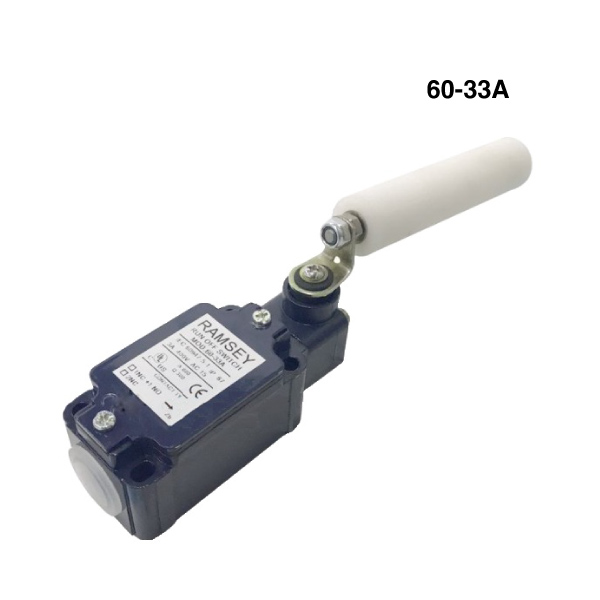


Run off switches detect excessive lateral movement of a conveyor belt before the belt, structure or conveyed material is seriously damaged.
What is a Run Off Switch?
The belt edge contacts a roller lever as it moves away from its normal track. The lever rotates a shaft and operates one or two switching points, commonly arranged as an early alarm followed by a conveyor trip.
A switch or sensor does not create safety integrity by itself. Its failure behavior, wiring, logic and final control element must be considered together and verified against the performance required by the application.
Typical applications
Typical uses span head and tail pulleys, loading zones, long overland conveyors, return-belt monitoring. Record the process condition and consequence at every tag because the same product family may serve indication in one area and equipment protection in another.
- head and tail pulleys: verify the actual operating condition, mounting geometry and required response before selecting a model.
- loading zones: verify the actual operating condition, mounting geometry and required response before selecting a model.
- long overland conveyors: verify the actual operating condition, mounting geometry and required response before selecting a model.
- return-belt monitoring: verify the actual operating condition, mounting geometry and required response before selecting a model.
How to select the right model
Separate mandatory characteristics from preferences. Contact utilization, positive opening, hazardous-area approval and permitted mechanical travel can be critical, while color or a familiar housing shape normally is not.
Record the proposed mounting point, normal state, alarm or trip action and reset sequence before ordering. A clear cause-and-effect entry prevents different assumptions between mechanical, electrical and control teams.
- Confirm the contact arrangement, utilization category and control voltage.
- Match the enclosure and ingress rating to dust, water, washdown and corrosion exposure.
- Check ambient temperature, cable entry, mounting dimensions and actuator geometry.
- For hazardous areas, verify the complete certificate and marking for the exact model.
Installation and commissioning guidance
Install switches in matched positions on both sides of the belt where drift is most likely. Set the roller clearance and angle from the actual running belt after tracking is correctly commissioned.
Use a rigid, low-vibration support and keep the actuator inside its specified approach and overtravel. Preserve sealing and earthing with compatible glands, then test the signal from the physical device through to the final control action.
Inspection and lifecycle care
Trend nuisance operations and slow or failed resets. Increasing event frequency often reveals a process, alignment, contamination or mounting problem before the device loses its function completely.
Never bridge or restrain a protective device to maintain production. Control the affected equipment, investigate the initiating condition and restore normal service only after corrective work and a successful test.
Specification, commissioning and lifecycle record
A dependable run off switch decision remains traceable from the operating requirement to the installed order code. Record the normal condition, abnormal trigger, required controller state, alarm or stop response, reset rule and inspection method before requesting quotations. This prevents commercial substitutions from changing the engineering function unnoticed.
Keep the approved datasheet, complete model suffix, terminal drawing, mounting sketch, certificates and commissioning result under the equipment tag. After replacement, adjustment, conveyor modification or control-software change, repeat the relevant physical proof test and update the as-built record. The test must demonstrate the field device, wiring, controller indication and final machine response rather than only a changing PLC input.
- Compare complete order codes and option suffixes.
- Confirm contact state under normal, actuated and fault conditions.
- Record the installed clearance, angle, tension, threshold or calibration.
- Inspect mounting, cable entries, seals, earthing and access.
- Set maintenance intervals from risk, environment, duty and failure history.
Frequently asked questions
Is a run off switch the same as a belt sway switch?
The terms are commonly used for the same type of belt misalignment detection device.
Why use two switching stages?
An early stage can warn operators while a later stage stops the conveyor before severe edge damage or spillage occurs.
Selection note: verify dimensions, operating principle, electrical data, environmental rating and certifications on the current datasheet for the exact ordered model.
Run off switches, also known as emergency stop switches, are safety devices designed to quickly and easily shut down machines and equipment in case of an emergency. These switches are essential in industrial settings where workers are in close proximity to heavy machinery and equipment, and where safety is paramount. In this article, we will discuss the function, types, and benefits of run off switches in more detail.
Function: The primary function of a run off switch is to quickly and safely shut down machinery or equipment in the event of an emergency. This could be due to a worker being in danger, a malfunction in the machine, or any other unforeseen circumstances. Run off switches are designed to be easy to access and operate, and can be triggered by a simple push or pull of a lever, button, or switch.
Run Off Switch Types
There are several types of run off switch available, each designed to meet specific safety requirements and regulations. The most common types include:
- Push-button switches: These are the most common type of run off switch and are usually located near the operator or in a central location that is easy to access. When the button is pressed, it triggers an electrical signal that shuts down the machine.
- Pull-cord switches: These switches are typically used in conveyor systems or other equipment that requires continuous operation. The pull-cord is located along the length of the conveyor or equipment, and when pulled, it triggers the switch, shutting down the entire system.
- Keyed switches: These switches are typically used in situations where only authorized personnel are allowed to operate the machinery or equipment. The key is inserted into the switch, and when turned, it triggers the shut down sequence.
- Rope switches: These switches are similar to pull-cord switches, but instead of a cord, a rope is used to trigger the shut down sequence. These switches are often used in applications where the cord may become tangled or damaged.
Benefits
The benefits of run off switches are numerous, and include:
- Enhanced safety: Run off switch are designed to quickly shut down machinery and equipment in case of an emergency, preventing injuries and accidents.
- Compliance: Many regulatory bodies require the use of run off switches in industrial settings to ensure compliance with safety standards.
- Protection of machinery and equipment: Shutting down machinery and equipment quickly can prevent damage and reduce repair costs.
- Easy to use: Run off switches are designed to be easy to access and operate, making them a simple and effective safety solution.
Run off switches are an essential safety device in industrial settings, designed to quickly and safely shut down machinery and equipment in case of an emergency. There are several types of run off switch available, each designed to meet specific safety requirements and regulations. The benefits of run off switches include enhanced safety, compliance with safety standards, protection of machinery and equipment, and ease of use. It is important to understand the different types of run